





HOMEPAGE
CLIMATE
CURRENCY
ECONOMY
GEOGRAPHY
HISTORY
HEALTH & SAFETY
VISAS
LANGUAGE
PEOPLE
TOURISTS
BEACHES
TRANSPORT


T O P   F E A T U R E
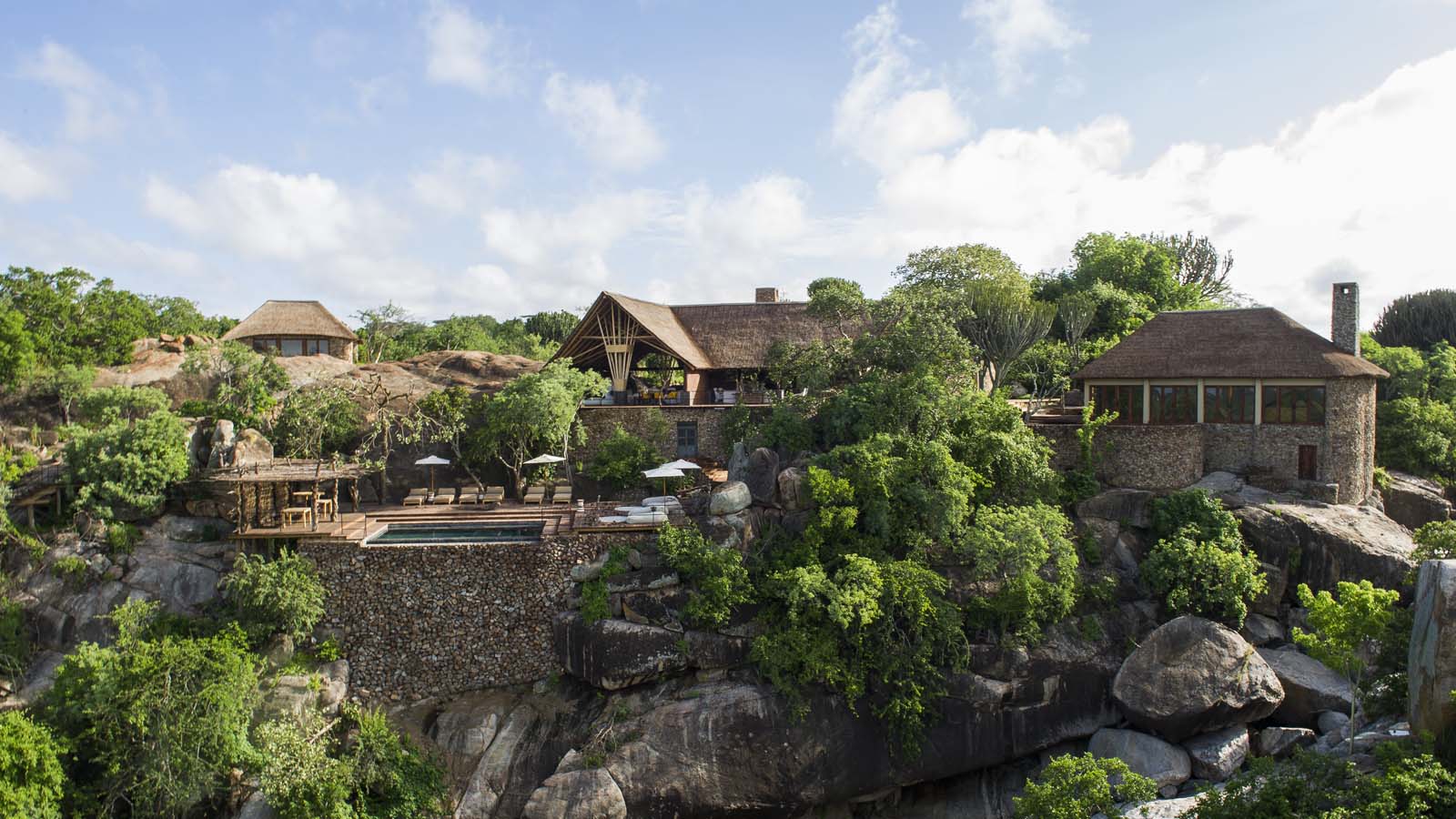
Barefoot Luxury
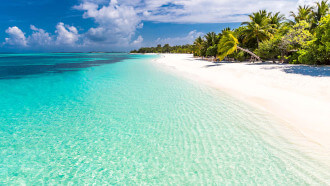
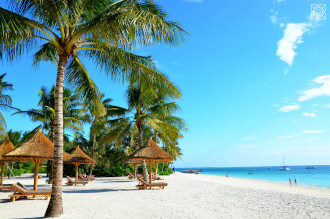
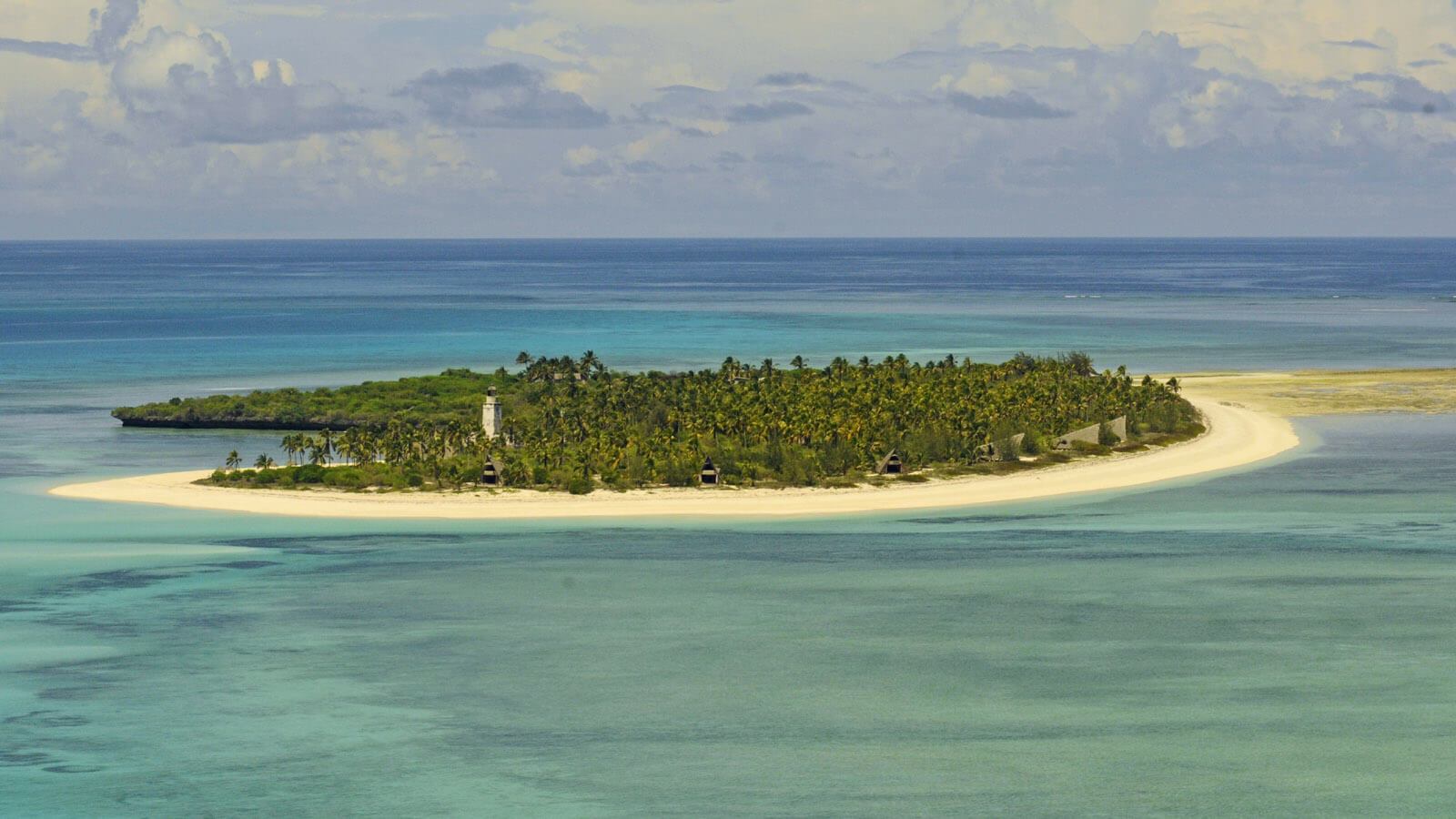
Situated on a glorious shoreline on the Tanzanian Coast, Amani Beach Club offers the opportunity for a holiday in paradise: luxurious, yet relaxed, exotic but comfortable.

Climate
Tropical climate with high temperatures and humidity on the coast and islands. Average daytime temperatures 23 Ecclus / 73 Fahrenheit from June to September and 27 Celsius 81 Fahrenheit from December to March. Annual rainfall is more than 1000 mm / 40 inches.
On the central plateau it is much drier. Annual rainfall 250 mm / 10 inches.
On peaks above 1,500 metres / 5,000 feet there is a semi temperate climate with permanent snow on the highest peaks.
TOP
Currency
Currency: Tanzanian Shilling divided into 100 Senti.
Credit Cards: Credit cards are only acceptable in the major tourist hotels, restaurants and gift shops.
Banking hours: 0830 to 1600 Monday to Friday and 0830 to 1300 Saturday.
Currency restrictions: Local currency cannot be imported except by residents of Tanzania, Kenya and Uganda. Local currency cannot be exported. Foreign currency can be imported and exported without limit.
TOP
Economy
Agriculture: Chiefly agricultural: Cloves, coffee, cotton, rice, sorghum, sugar, coconuts, tobacco.
Mining: Iron, Salt, Oil, coal, tin, gypsum, gold, diamonds, phosphate.
Manufacturing: Textiles, food processing, cement, cigarettes.
Other: Tourism is of considerable importance particularly in the north.
TOP
Geography
Official name: United Republic of Tanzania.
Population: 24,500,000 (estimate 1990).
Situation: East Africa.
Timezone: GMT + 3
Area: 939,652 square kilometres /362,706 square miles.
Borders with: Burundi, Kenya, Malawi, Mozambique, Rwanda, Uganda, Zambia, Zimbabwe.
Coasts: Indian Ocean.
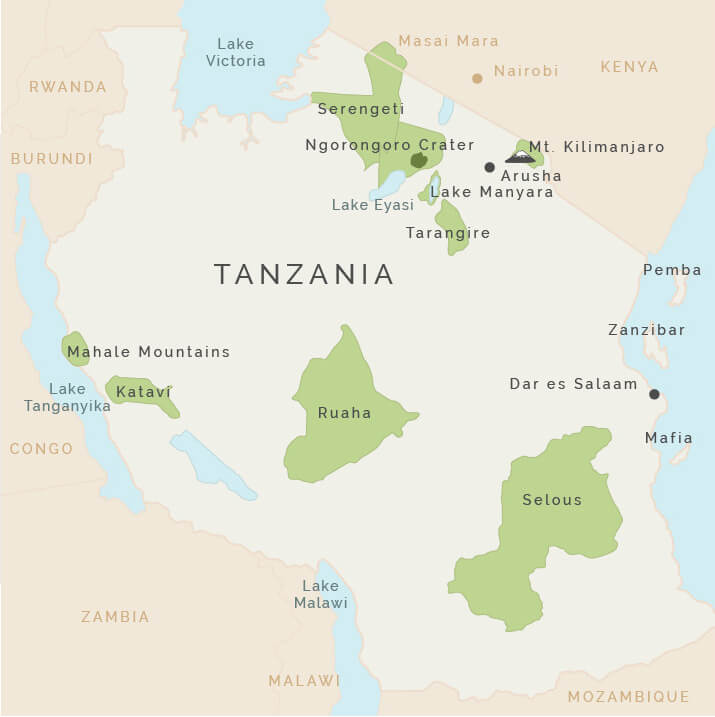
Capital: Dar Es Salaam.
Major Towns: Arusha, Mwanza, Tanga, Zanzibar.
Chief Port: Dar Es Salaam.
Religion: Christianity (35%) on the mainland. Islam on Zanzibar Island.
Rest Day: Sunday.
Electricity: 230 Volts AC, 50 Hz.
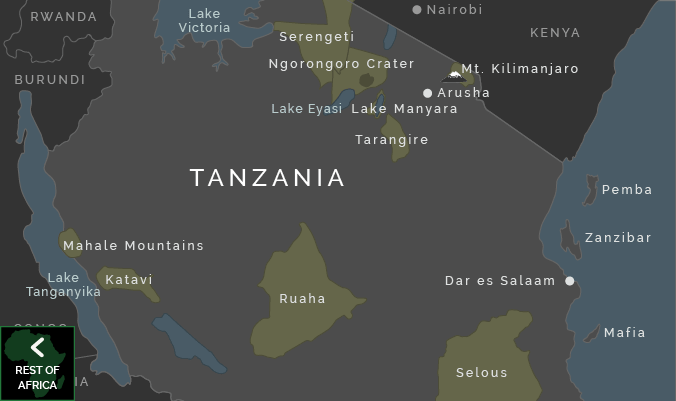
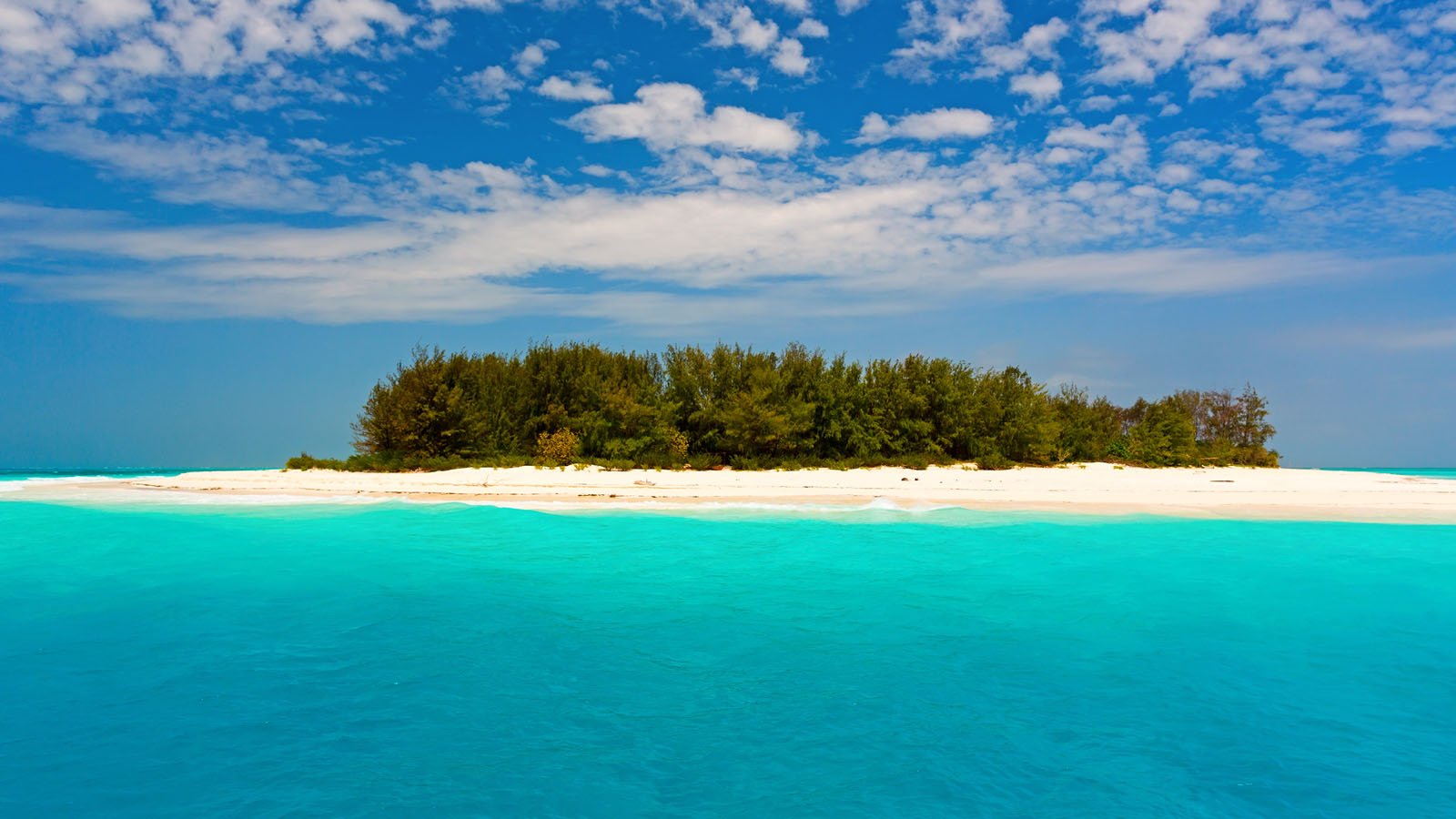
Physical: The largest country in East Africa. Consists of the mainland plus the major islands of Zanzibar, Pemba and Mafia. The coast is protected by a coral reef. A large central plateau with grasslands and mountain ranges, with Mt Kilimanjaro in the north being the highest mountain in Africa at 5,895 meters /19,340 feet. The Great Rift Valley runs through the centre of the country and contains many lakes. In the north the country borders Lake Victoria and in the west Lake Tanganyika.
TOP
History
The country of Tanzania is a result of the political union between mainland Tanganyika and the off-shore islands of Zanzibar and Pemba.
The two parts of the union attained independence from Britain separately, the mainland in 1961 and Zanzibar in 1963.
The coastal area has been the subject of a lot of maritime rivalry first between the Portuguese and Arab traders and later between various European powers.
It was not until the middle of the 17th century when Arab traders and slavers first entered the country.
Zanzibar had become so important as a slaving and spice entrepot by the first half of the 18 hundreds that the Oman Sultan, Seyyid Said moved the capital there from Muscatel in 1840.
From the beginning of the 19th century Britain's intrust stemmed when a treaty was signed with Seyyid Asides predecessor to forestall possible threats from Napoleonic France to British possessions in India.
Seyyid Said moved to Zanzibar, the British set up their first consulate there, Britain made Oman Sultan sign treaties restricting the slave trade.
In 1873 due to the threat of naval bombardment Sultan
Barghash (Seyyid Said's successor) signed a treaty outlawing the slave trade, although this trade continued on the mainland.
A British protectorate was placed on Zanzibar in 1890 it remained this way until 1963 when independence was granted.
In 1964 the Sultan was toppled in a communist-inspired revolution, during this the majority of the Arab population were massacred or expelled.
Sultan was replaced by the Afro-Shirazi Party.
It was during the reign of this party that Zanzibar and Pemba were merged with Tanganyika to form Tanzania.
It was in the middle of the 19th century when the European explorers began arriving, four of the most famous being Livingstone and Stanley, Burton and Speke.
In 1891 the Germans colonised the mainland and it was governed directly by the German government.
The British were mandated the territory by the League of Nations after WORLD WAR 1.
In 1954 the Tanganyika African National Union (TANU) was founded by Julius Nyerere, and they made nationalist organisations a great success.
In 1961 Tanganyika achieved independence the country's first president was Nyerere.
In 1967 the Arusha Declaration was created, as a result of the neglect of education, this was heavily influenced by the Chinese communist model.
The villages were intended to be socialist organisations created by the people and governed by the people.
Education was seen as essential to educate people into socialist ideas.
The economy was nationalised and taxes were increased, Nyerere banned government ministers and party officials from having shares or directorships in companies or from receiving more than one salary, this was an attempt to prevent the development into an exploitative class.
The villages since development have been transformed from peasant control to direct state control and new schemes were introduced, such as potable water, clinics, schools, fertilisers, high yield seeds and irrigation these schemes all failed due to lack of money and resentment among the peasants.
Corruption became widespread.
A third scheme was adopted to encourage the peasants to amalgamate their small holdings into large communially owned farms, this scheme was relatively successful and the government were prompted to adopt a policy of compulsory "villagisation" of the entire rural population.
Nyerere turned to the People's Republic of China as his foreign partner, the Chinese built a brand new railway for Tanzania from Dar es Salaam to Kapiri Mposhi, named the TAZARA railway, due to the rise in price of oil in the 1970's Tanzania had no money to maintain the railway, there were also serious fuel shortages.
Tanzania was bankrupted due to Nyerere's support of the guerrillas fighting for the independence of Angola and Mozambique against the Portuguese and also those fighting to overthrow the White minority government of Rhodesia.
In 1978 Idi Amin sent his army into northern Tanzania, as a result of Tanzania supporting exiled groups who were hostile to his regime, but it was more likely that it was simply a diversion to prevent mutiny in his own country, it took months for the Tanzanians to mobilise an army but when they did face the Ugandans, the Ugandans threw down their arms and fled, the Tanzanians pushed into Uganda, they left approximately 12 000 troops within the country, Tanzania was then condemned by the OAU due to the fact that the OAU's principle is that no state should interfere with the internal affairs of another.
Nyerere also helped to topple two other regimes in 1975 in the Comoros Islands and in 1977 in the Seychelles.
Kenya, Tanzania and Uganda were linked together in an economic union after independence, which shared a common airline, telecommunications and postal facilities, transportations and customs, also their currencies were convertible, there was freedom of movement.
In 1977 this fell apart as a result of political differences.
Nyerere closed his country's borders with Kenya as a consequence of Kenya grabbing the bulk of the communities assets. These have been opened since.
In 1985 Nyerere stepped down but he then became the chairman of his party Chana Cha Mapinduzi (the CCM-Party of the Revolution).
Ali Hassan Mwinyi has been president since.
TOP
Health & safety
Compulsory immunizations:
Cholera - a serious infection of the intestine. The infection is called Vibrio cholerae and is usually caused through drinking contaminated water. The symptoms are a sudden, watery, diarrhoea which very rapidly dehydrates the body bringing the suffer to a state of shock with death following within 2 days. If diagnosed and treated rapidly with the replacement of body fluids, death is uncommon. Although not officially compulsory, cholera certificate can be requested at the borders.
Yellow Fever - infection caused by a virus carried by monkeys, transmitted through mosquitos who carry the virus from the monkey to the human. The symptons a re a short, mild fever often leading to jaundice, failure of the liver and kidneys and eventually death. The vaccine is effective. The vaccination is valid for 10 years and is usually only available in specialist clinics or hospitals. A valid Yellow Fever inoculation certificate is required if arriving from or via an infected area having passed through that area by any other means than a scheduled flight. A yellow fever inoculation certificate is required if arriving from or via an infected area.
Recommended immunizations:
Hepatitis A - also called 'infectious hepatitis' - is basically an inflammation of the liver caused by a virus A. The virus is picked up from contaminated food and water. The symptoms are a slight febrile disorder, loss of appetite and jaundice. Almost everyone recovers within about 2 months. Precautions include immunization and avoiding salads, unpeeled fruit, sharing crockery and cutlery.
Malaria - a danger in the lowland areas of Northern and Eastern Transvaal and parts of Eastern Natal reaching down to the Tugela River.
Polio or Poliomyelitis - an infection caused by a virus. It affects the motor neurone cells in the spinal cord mainly. The symptoms are fever and headache, weakness in a group of muscles, then widespread paralysis. Sometimes there is respiratory paralysis and rapid death. There is an effective vaccine taken by mouth.
Tetanus - (also known as lockjaw) - is a disease caused by infection with 'clostridium tetani' which is present in soil and in the intestines of humans and animals. Infection can enter the body via cuts after which bacteria produce a toxin affecting the motor nerve cells in the spinal cord. This is followed by convulsions and muscle spasms. The vaccine is effective and the disease can also be treated by an antitoxin and penicillin.
Typhoid - or 'enteric fever' - is caused by infection with 'salmonella typhi'. The infection is passed from infected water, milk or food or by people preparing food or drinks. Symptoms are a rapidly fluctuating temperature, drowsiness, diarrhoea, abdominal rash, delirium and coma. Immunization is effective. The disease is treatable with antibiotics.
Yellow Fever Food Precautions: Avoid - unpeeled fruit, badly cooked meat, icecubes, untreated milk, ice cream if made from untreated milk.
Take - Extra salt if in hot climates.
Yellow Fever Drink Precautions: Purify water or make sure it is clean. If you are not sure avoid it. Bottled water, soft drinks (sodas) and beer are usually widely available.
Crime: Street crime in Dar es Salaam can be a problem. Avoid walking alone at night and you are advised against flaunting wealth.
TOP
Visas
Countries whose nationals do not require a visa although they do require a visitors pass which should be obtained before departure include:
+ Antigua & Barbuda, Australia, Bahamas, Bangladesh, Barbados, Belize, Botswana, Brunei Darussalam, Canada, Cyprus, Denmark, Dominica, Fiji, Finland, Gambia, Ghana, Grenada, Guyana, Iceland, Ireland, Jamaica, Kenya, Kiribati, Lesotho, Malawi, Malaysia, Maldives, Malta, Mauritius, Nauru, New Zealand, Norway, Papua New Guinea, Rwanda, Saint Kitts & Nevis, Saint Lucia, Saint Vincent & The Grenadines, Samoa, Seychelles, Sierra Leone, Singapore, Solomon Islands, Sri Lanka, Swaziland, Sweden, Tonga, Trinidad & Tobago, Tuvalu, UK (being a citizen of the United Kingdom & Colonies), Uganda, Vanuatu, Zambia, Zimbabwe.
Countries whose nationals do require a visa include: All those not included above.
Visas are obtainable at Tanzanian Embassies and High Commissions.
TOP
Language
Official: English and Swahili.
Other: Many very localised languages and dialects.
TOP
People
Tribes: More than 100 tribal groups many of Bantu origin. In Zanzibar and Pemba there is a strong Arab, Shirazi and Comorian influence.
TOP
Tourists
TANZANIA, Dar es Salaam
- Tanzanian Tourist Corporation, PO Box 2485
- Tel: +255 51 27671
- Fax: +255 51 46780
- Tlx: 41061
 
+ TANZANIA, Arusha
- Tanzania Wildlife Corporation, PO Box 1144
- Tel: +255 57 8830
- Fax: +255 57 8239
 
USA, New York
- Tanzanian Tourist Office, 8th Floor
- 205 East 42nd Street, New York 10017
- Tel: +1 (212) 972 9160
- Tlx: 220782
TOP
Beaches
DAR ES SALAAM: There are a number of resort hotels to the north of Dar es Salaam. Limited range of water sports and activities but windsurfing, snorkelling and boat trips are available.
+ Bahari Beach Hotel
+ Kunduchi Beach Hotel
TOP
Transport
Internal flights:
+ DAR ES SALAAM: There are internal flights between Dar es Salaam and:
- Kigoma, Kilimanjaro, Lindi, Mtwara, Musoma, Mwanza, Pemba, Songea, Tabora, Tanga and Zanzibar.
+ KIGOMA: There are internal flights between Kigoma and:
- Dar es Salaam, Mwanza and Tabora.
+ KILIMANJARO: There are flights with Air Tanzania, between Kilimanjaro and:
- Dar es Salaam, Musoma, Mwanza and Zanzibar
+ LINDI: There are internal flights between Lindi and:
- Dar es Salaam.
+ MTWARA: There are internal flights between Mtwara and:
- Dar es Salaam.
+ MUSOMA: There are internal flights between Musoma and:
- Dar es Salaam, Kilimanjaro.
+ MWANZA: There are internal flights between Mwanza and:
- Dar es Salaam, Kilimanjaro.
+ PEMBA: There are internal flights between Pemba and:
- Dar es Salaam, Tanga, Zanzibar.
+ SONGEA: There are internal flights between Songea and:
- Dar es Salaam.
+ TABORA: There are internal flights between Tabora and:
- Dar es Salaam, Kigoma.
+ TANGA: There are internal flights between Tanga and:
- Dar es Salaam, Pemba, Zanzibar.
+ ZANZIBAR: There are internal flights between Zanzibar and:
- Dar es Salaam, Pemba and Tanga.
TRAIN: There are trains between:
+ Dar es Salaam and:
- Dodoma
- Kigoma
- Moshi
- Mpanda
- Mwanza
- Tabora
- Tanga
- Tunduma
BUS: Buses and minibuses operate on the main sealed roads for longer distances and locally, minibuses or shared taxis will operate on poorer quality roads. Routes operating on the better roads include:
+ Dar es Salaam to Arusha.
+ Dar es Salaam to Moshi.
+ Dar es Salaam to Morogoro.
TAXI: Taxis are available in the main centres. There is no metering and it is essential that you agree a fare before departure.
CAR RENTAL
- Driving:
On the left hand side of the road as in UK, Japan etc.
- Road Conditions:
Some roads are in very poor condition. 4 wheel drive is useful and in the wet seasons when travelling anywhere but on the major routes.
- Self Drive:
Self drive car rental is not popular in Tanzania but is possible. Usually, a car is hired with a driver, which, considering the state of some of the hire cars and the poor condition of some of the roads, can be an advantage.
- Car rental companies:
Hertz
- PO Box 20517, Dar es Salaam.
- Tel: +255 51 35437
BOAT: Boats including ferries, operate on Lake Malawi, Lake Tanganyika, Lake Victoria and on the Indian Ocean to and between Zanzibar, Pemba and Mafia Islands.
+ Indian Ocean
- Dar es Salaam to Pemba Island.
- Dar es Salaam to Zanzibar Island.
- Tanga to Pemba Island.
+ Lake Malawi
- Itungi to Mbamba Bay.
+ Lake Tanganyika
- Kigoma to Gombe Stream National Park.
+ Lake Victoria
- Mwanza to Bukoba.
TOP
Copyright ©1998 Internet Africa Ltd. All rights reserved. This material may not be published, broadcast, rewritten or redistributed in any form. Please click here for legal restrictions and terms of use applicable to this site. Use of this site signifies your agreement to the terms of use. Email Us with any suggestions or contributions.